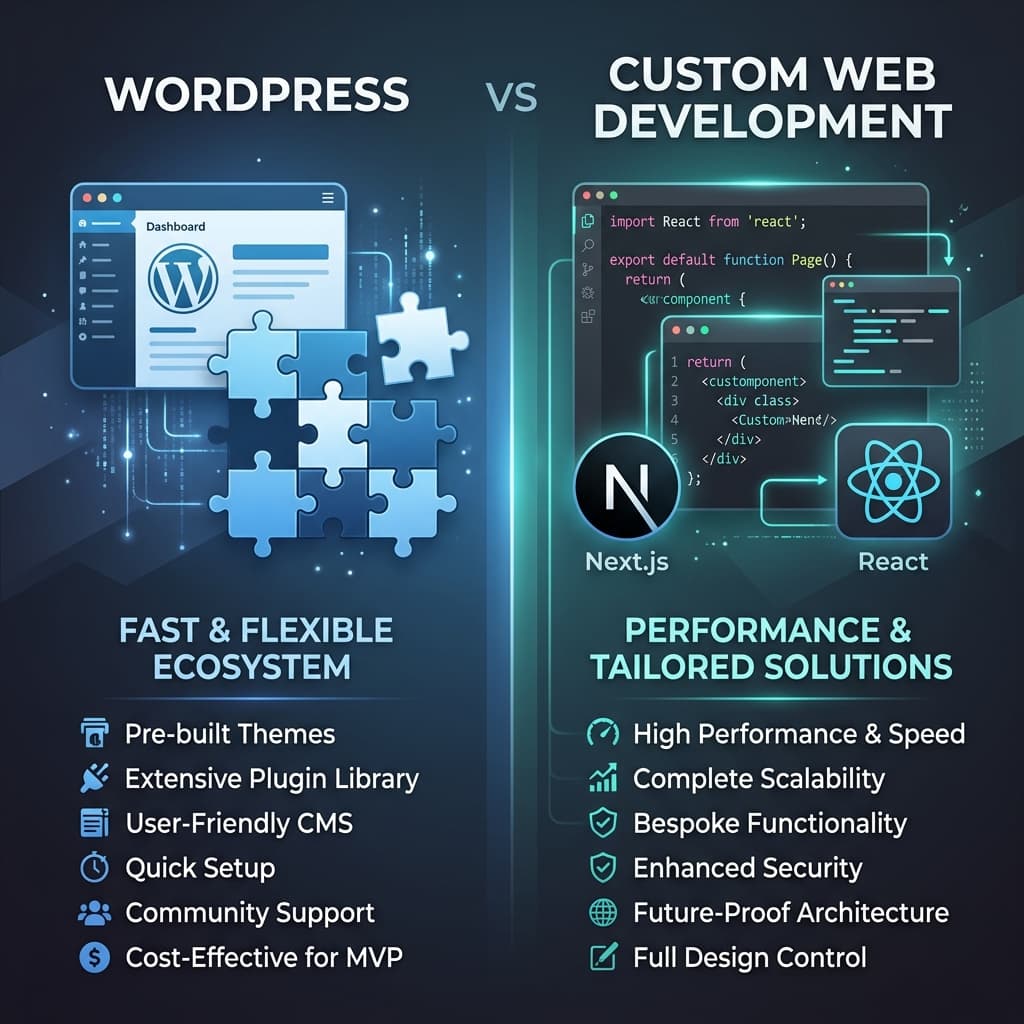
WordPress vs Custom Websites: Which Is Best for Your Small Business?
2026-05-22 • RedSun IT Services
WordPress vs Custom Websites: Which Is Best for Your Small Business?
When starting a new web development project, small business owners face a fundamental question: Should you build on WordPress, or invest in a custom-coded website?
WordPress powers over 43% of the internet, making it the default choice for millions of businesses. However, custom-coded web architectures—built on modern frameworks like React and Next.js—have surged in popularity, particularly for high-growth businesses that refuse to compromise on loading speed, security, and unique design.
Making the wrong decision can lead to slow loading speeds, constant security hacks, bloated code, and limited SEO rankings.
Here is an honest, head-to-head comparison of WordPress and custom websites, broken down by cost, speed, security, SEO, and scalability, to help your business make the right decision.
1. WordPress: The Plugin-Driven CMS
WordPress is a Content Management System (CMS) originally built for blogging. Today, it is used for everything from simple portfolio sites to complex online stores.
The Advantages of WordPress
- Lower Initial Cost: Because of pre-built templates and visual page builders (like Elementor, Divi, or Gutenberg), developers can build WordPress sites quickly, resulting in lower upfront setup costs.
- Easy Content Management: Non-technical marketing teams can log in and publish blog posts, swap out text, or add new landing pages without writing a single line of code.
- Massive Plugin Ecosystem: Want to add an event calendar, a contact form, or SEO tracking? There is likely a free or cheap plugin that solves your problem in minutes.
The Drawbacks of WordPress
- Plugin and Code Bloat: To achieve modern design layouts, many WordPress sites rely on heavy themes and dozens of plugins. Each plugin loads its own JavaScript and CSS files, dragging down page speed.
- Frequent Security Hacks: Because WordPress is so popular, it is the number one target for global hackers. Over 90% of hacked CMS websites run on WordPress, usually due to outdated plugins or unpatched core code.
- Constant Maintenance: Plugins, themes, and WordPress core files require weekly updates. If left unmaintained, plugins can conflict, breaking your site’s layout or causing database errors.
- Design Limitations: While page builders allow drag-and-drop design, achieving highly custom layouts often requires rewriting complex CSS styles, bypassing the template's speed advantages.
For businesses looking for a straightforward setup, investing in lightweight, professionally configured WordPress development services can bypass many of these speed and theme issues.
2. Custom Websites: The High-Performance Alternative
A custom website is built from scratch. Instead of using a CMS template, developers write clean code using modern frontend languages (like React or Next.js) and connect it to lightweight databases or headless content editors.
The Advantages of Custom Websites
- Unmatched Page Speed: Because there are no heavy plugins or bloated template databases loading in the background, custom sites load almost instantly. A custom Next.js site delivers pre-rendered HTML files to the browser, optimizing Core Web Vitals out-of-the-box.
- Ironclad Security: Custom sites do not have a standard backend login URL (like
/wp-admin) or database structure for hackers to exploit. With no plugins to target, the risk of automated hacking is close to zero. - 100% Design and UX Freedom: Designers are not restricted by pre-made theme settings. Every section, font, and animation can be custom-crafted to represent your brand.
- No Hidden Maintenance Cost: Custom sites do not break because a plugin updated. Once built, the core layout remains stable and functional for years with minimal intervention.
The Drawbacks of Custom Websites
- Higher Upfront Investment: Writing code from scratch requires senior software developers. This makes the initial development cost higher than launching a pre-made template.
- Harder Content Management: If not built on a "headless CMS" (like Sanity or Strapi), simple changes to text or images may require a developer to modify the code.
For businesses looking for custom tools, client dashboards, or advanced automation, professional custom web applications offer the ideal balance of speed, styling, and flexibility.
3. Head-to-Head Comparison
| Feature | WordPress | Custom Coded Websites |
|---|---|---|
| Upfront Cost | Low to Moderate | Moderate to High |
| Ongoing Maintenance | High (Weekly updates required) | Very Low (Stable code) |
| Loading Speed | Slow to Average (Plugin-heavy) | Extremely Fast (Instant static generation) |
| SEO Authority | Good (E.g. Yoast / RankMath plugins) | Excellent (Clean code structure & speed) |
| Security Risk | High (Subject to automated exploits) | Almost Zero (No database/CMS files to target) |
| Design Flexibility | Limited by theme template | 100% Custom |
| Scalability | Good for blogs; poor for custom software | Infinite (Easily integrates custom web apps) |
4. Key Factors to Consider
Speed and Core Web Vitals
As we discussed in our article on why slow websites lose customers and rankings, loading speed is no longer just a UX metric—it is a primary Google ranking signal.
WordPress sites can be optimized, but it requires caching plugins, CDNs, and clean database scripts. Custom sites (especially those utilizing static page generation) naturally load in under a second, giving you a competitive ranking advantage on day one.
Cost Efficiency
When looking at custom website vs WordPress costs, do not just calculate the upfront design fee.
A cheap WordPress site can become expensive if you factor in:
- Paid premium plugin licenses (yearly subscriptions).
- High-performance managed WordPress hosting (to combat slow database loading).
- Monthly maintenance fees paid to a developer to ensure updates do not break your site.
A custom site has a higher initial setup cost but near-zero monthly maintenance fees, making it highly cost-efficient over a 3-to-5-year period.
Lead Generation and Conversions
Your website is meant to be a sales engine. In our guide on why small business websites fail to generate leads, we highlight that visual clarity, speed, and call-to-actions (CTAs) are critical.
While WordPress allows you to drag-and-drop lead forms, custom sites allow developers to integrate high-converting interactive tools (like customized price estimate forms, multi-step booking systems, and live AI sales agents) smoothly without breaking the visual flow or adding JS lag.
Protecting Your Search Rankings
If you are planning to transition from an existing system to a new site, you must ensure that your current rankings do not disappear. Utilizing a detailed website redesign checklist for Canadian businesses is critical to map URLs, preserve metadata, and ensure a smooth migration.
Which Option Is Best for Your Small Business?
Choose WordPress if:
- Your development budget is under $3,000.
- You need a basic informational website up and running in less than two weeks.
- You want your marketing team to edit page structures and visual modules without developer help.
- Your site is primarily text-based, and you do not require custom software features.
Choose a Custom Website if:
- Your business operates in a highly competitive local market where search rankings and Core Web Vitals are critical.
- You require absolute data security (e.g., medical clinics, financial companies, or legal services).
- You want a premium, high-converting design that is completely unique to your business.
- You plan to scale your website into a SaaS platform, a membership portal, or integrate custom software tools (like customer dashboards or automated lead scoring pipelines).
- You want a future-proof foundation. Read more about why every brand needs a custom website in the age of AI automation.
Secure Your Digital Future with Red Sun IT Services
At Red Sun IT Services, we do not believe in one-size-fits-all solutions. We design and deploy digital structures tailored to your specific business targets:
- For businesses seeking flexible content platforms, we build lean, fast WordPress websites with hand-coded custom themes and minimal plugin dependency.
- For high-growth brands seeking maximum performance, custom workflows, and premium security, we build custom Next.js web applications that load instantly and scale endlessly.
👉 Contact Red Sun IT Services today for a free, comprehensive consultation to help you choose the perfect platform for your next website project.