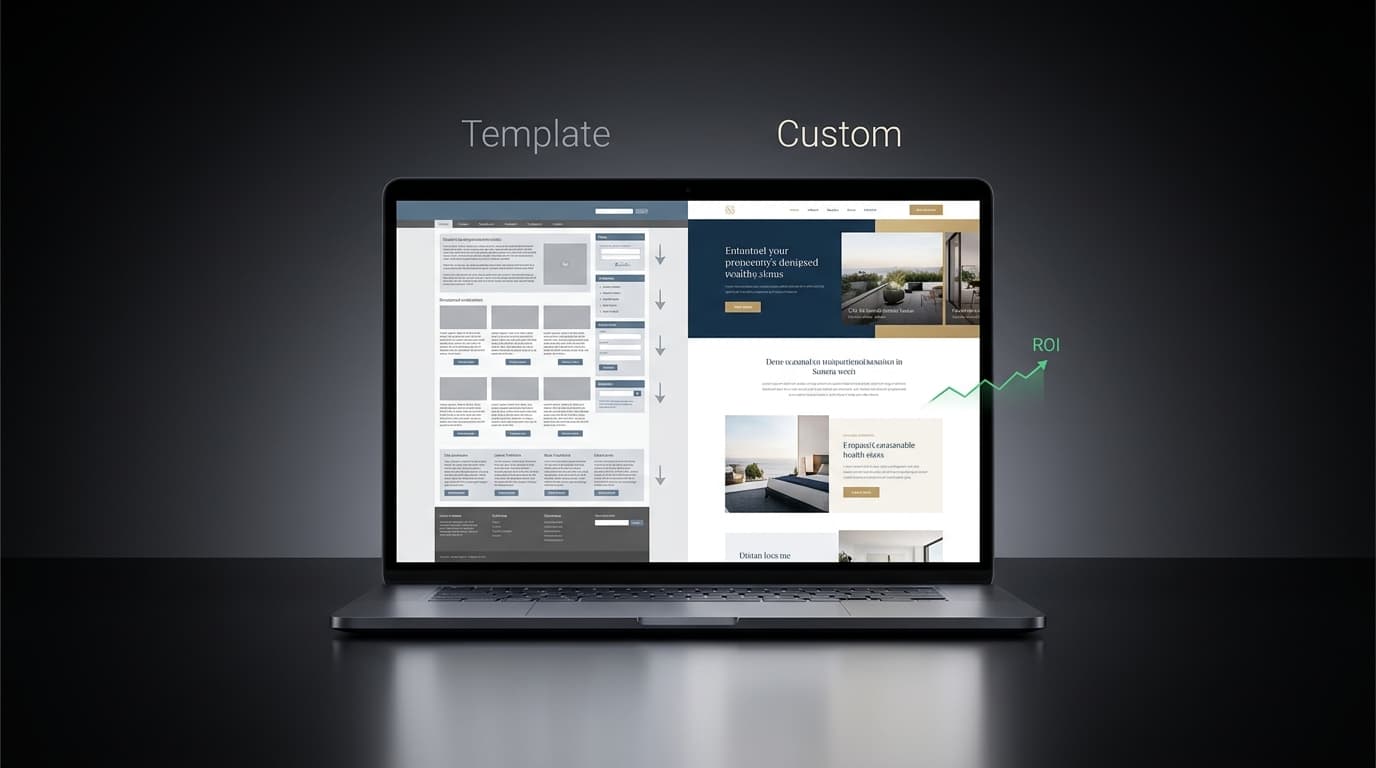
Custom Website vs Template Cost Comparison | Red Sun IT Services
2026-04-26 • RedSun IT Services
The Hidden Financial Trap: Custom Website vs Template Cost Comparison
When it is time for a business to establish its digital footprint, business owners encounter a massive fork in the road almost immediately. On one side, there are heavily advertised commercial templates that promise a beautiful, functional website for an incredibly low price—sometimes just $50 to $100. On the exact opposite side lies custom website development, where professional agencies estimate costs in the thousands or tens of thousands of dollars.
For the budget-conscious entrepreneur, the $50 template looks like an incredibly attractive, financially responsible, no-brainer decision. However, in the professional web development world, there is a saying: "Nothing is more expensive than a cheap website."
In this comprehensive guide, we will analyze the great custom website vs template debate. We will rip off the attractive initial price tag to reveal the severe hidden costs of templates, explore why custom development generates exponentially more revenue, and determine exactly which route makes the most long-term financial sense for your specific business goals.
1. Defining the Contenders: Template vs. Custom
Before calculating the financial comparison, we must rigorously define exactly what each option entails. The structural difference significantly impacts the financial outcome.
What is a Template Website?
A template (or pre-made theme) is a mass-produced, pre-designed website layout available for public purchase on marketplaces like ThemeForest, Envato, or through builders like Wix and Squarespace. The developers of these templates aim to sell the exact same design to 50,000 different buyers. To appeal to everyone (from a high-tech lawyer to a local bakery), the code is stuffed with dozens of layout options, massive slider plugins, hundreds of fonts, and heavy styling elements.
- The Initial Allure: It looks visually impressive out of the box and is exceptionally cheap to acquire initially.
What is a Custom Website?
A custom website is built entirely from a blank canvas. An agency performs deep market research on your competitors, outlines a strategic user journey specifically for your local clients, designs a unique interface, and then writes clean, lightweight code to bring that specific design to life. There is no bloated code, no generic "one-size-fits-all" plugins, and it perfectly aligns with your brand.
- The Initial Reality: It demands a higher upfront financial investment but is built to be a high-performance business asset.
2. The Illusion of the Cheap Initial Price Tag
The most dangerous aspect of the custom website vs template argument is the sheer illusion of the upfront cost. Evaluating a website's total financial impact simply by looking at the initial purchase receipt is highly misleading.
Let us look at a realistic scenario for a business owner opting for a template:
- The Theme Cost: $60.
- The "Setup" Realization: The business owner installs the theme and quickly realizes it looks absolutely nothing like the beautiful demo version because their images are different sizes and they lack the exact copy lengths used in the preview.
- The Hourly Freelancer: Frustrated, the owner hires a freelancer to try and force their content into the rigid template boxes. The freelancer spends 20 hours wrestling with terrible, bloated theme code at $50/hour. Cost: +$1,000.
- The Plugin Band-Aids: The template lacks a custom booking feature, so premium third-party plugins must be purchased and integrated. Cost: +$300/year.
- The Final Result: A website that cost around $1,500, took three weeks of frustration, loads terribly slowly due to awful code, and looks exactly like three other competitors in the region who bought the same template.
Suddenly, that "$60 bargain" has transformed into an ongoing financial and operational nightmare.
3. Performance and Speed: The Hidden Cost of Code Bloat
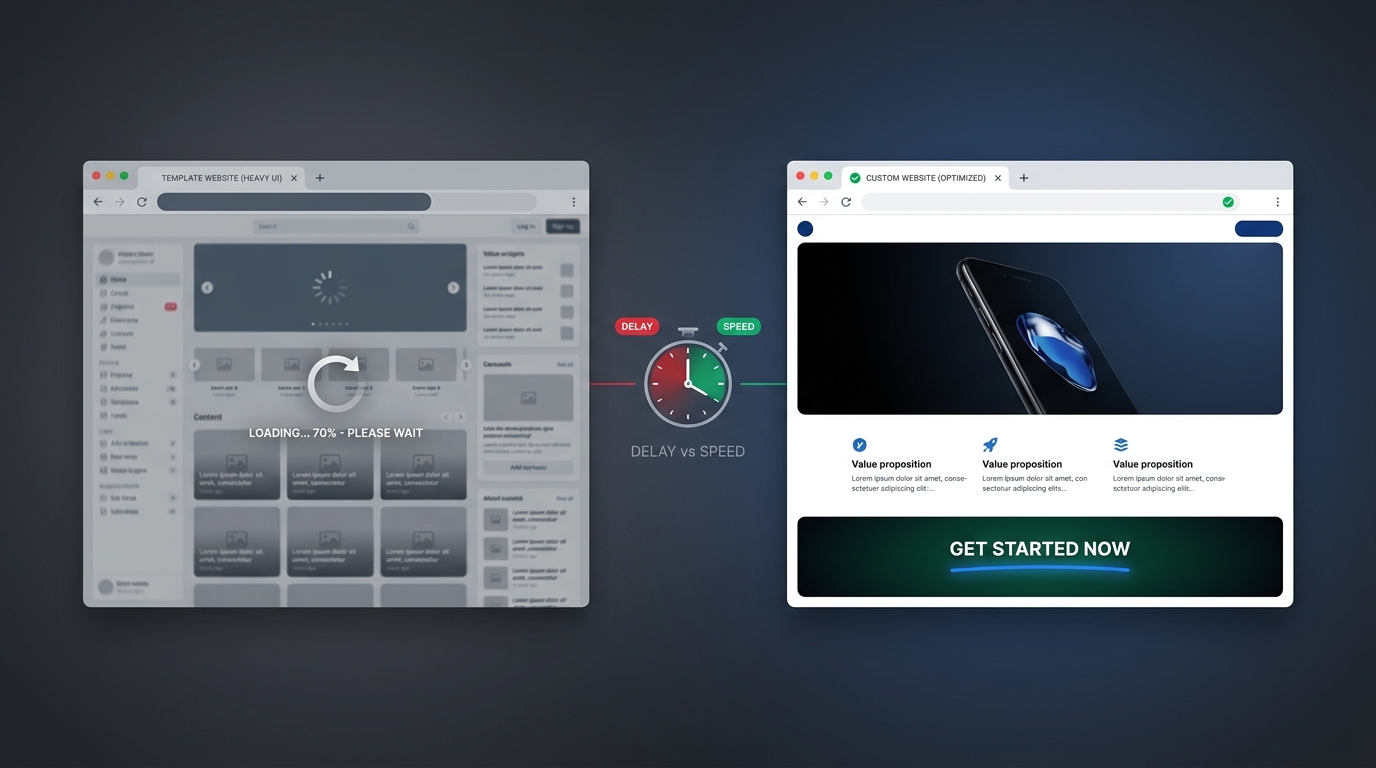
In modern web development and SEO, speed is paramount. Google has explicitly stated that Core Web Vitals (which heavily measure page load speed) are significant ranking factors. Furthermore, statistical studies show that if a website takes longer than 3 seconds to load, over 50% of mobile users will abruptly leave (a "bounce").
When analyzing custom website vs template, performance is where templates mathematically cost you thousands in lost revenue.
- Template Bloat: To function for thousands of different buyers, modern templates load massive libraries of CSS and JavaScript on every single page load—even if you are only using 5% of those features. The server has to process massive, unnecessary files before showing the user your content. This results in heavy, sluggish websites.
- Custom Lean Code: A custom website only contains the exact code necessary to display your specific layout. Period. It is an optimized, lightweight racing machine. A custom site will load in 1 to 2 seconds, maintaining the user’s attention and signaling extreme quality to Google's ranking algorithm.
Financial Impact: If your bloated template site gets 1,000 visitors a month, and a slow load time drives away 20% of them (200 lost users), and your average customer is worth $500 to you—that slow template just cost you $100,000 in lost annual potential revenue.
4. The SEO Handicap in Pre-Made Templates
A beautiful website that ranks on page 7 of Google is structurally useless. Search Engine Optimization (SEO) dictates how easily your local customers can find you.
Many commercial templates aggressively advertise themselves as "SEO Friendly." In reality, this usually just means they allow you to click a button to install the Yoast SEO plugin. It does not address the deeper architectural requirements of technical SEO:
- Heading Structure: Templates often mistakenly use multiple
<h1>tags or break the sequential logic of headers simply for stylistic purposes. This severely confuses Google’s web crawlers. - Schema Markup: Most templates lack rigorous, custom schema markup (which tells search engines exactly if you are a local business, what you sell, your reviews, etc.).
- Mobile Usability Flaws: Elements that look great on the template creator's desktop monitor often overlap or break entirely on different mobile devices, heavily penalizing your mobile SEO ranking.
A custom website is built precisely around SEO logic. The architecture, internal linking structures, heading tags, and server-side logic are tailored specifically to dominate search results for your chosen keywords.
5. Security Vulnerabilities: The Risk of Shared Code
A critical element often ignored in the custom website vs template debate is cybersecurity infrastructure. When cheap sites break, you often get trapped by massive hidden costs of website development.
Commercial templates (especially popular WordPress ones) are enormous targets for global hackers. Why? Because if a hacker finds a single security flaw in a popular template's code, they can simultaneously compromise 50,000+ different websites that run that exact same template. Furthermore, to make templates functional, owners often must install a fragile web of 20+ different third-party plugins. If a single plugin author stops updating their code, it creates an immediate backdoor vulnerability into your database.
Custom websites minimize this "surface area" of attack. By utilizing customized server-side logic and vastly significantly minimizing reliance on third-party public plugins, professional agencies build a fortress around your data. Removing technical vulnerabilities protects your business from disastrous downtime and crippling reputational damage.
6. The Scalability Problem: Outgrowing the Box
Businesses are structurally designed to scale and pivot. Your website needs to pivot seamlessly alongside your operational goals.
- The Template Cage: Six months after launching a template, you decide you want to add a sophisticated client portal or fundamentally change the checkout flow. You ask a developer to do it. They tell you that you cannot—the template's architecture rigidly prevents it. The only solution is to entirely scrap the template and build a new site from scratch. You effectively paid for a site that lasted six months.
- The Custom Foundation: Custom-built platforms (whether raw code or customized headless CMS architectures) are inherently modular. Adding a massive new feature does not require destroying the current site; developers simply build the new functionality and attach it seamlessly to the existing robust architecture. You are building a long-term asset, not renting a rigid box.
7. The True Benefit: Branding and Conversion Rates
Ultimately, a website's primary function is to establish unquestionable trust and convert visitors into highly qualified paying leads.
A template forces you to shove your unique brand voice, your unique selling propositions (USPs), and your localized services into pre-determined square boxes that generic designers created two years ago.
When a high-quality client lands on your page, sub-conscious branding triggers occur within milliseconds. If your site looks generic, uses cliché stock structures, or feels inconsistent, trust evaporates.
A custom website built by Red Sun IT Services perfectly maps the psychology of your ideal buyer. We route the user's eye exactly where we want it. We design custom interactive elements that delight users. We ensure that absolute brand consistency positions you as the single premium, undeniable authority in your local geographic market.
8. Conclusion: Which Path is Right For You?
The custom website vs template argument ultimately comes down to your operational goals and business maturity:
- Choose a Template IF: You are a hobbyist, a brand-new solo operation with zero initial capital attempting to validate a simple idea, or if a website is purely an informational "online business card" where you expect zero inbound digital leads.
- Choose a Custom Website IF: You are a real business seeking growth, if you rely heavily on Google traffic, if your brand image is vital to charging premium prices, and if you view a website as a strategic investment capable of generating massive quantifiable revenue.
If you are ready outgrow restrictive, cheap solutions and want to invest in digital real estate that actually drives business forward, let the experts at Red Sun IT Services design a fortress for your brand's future.
Book your free completely transparent strategy session today and let us map out your custom digital success plan.