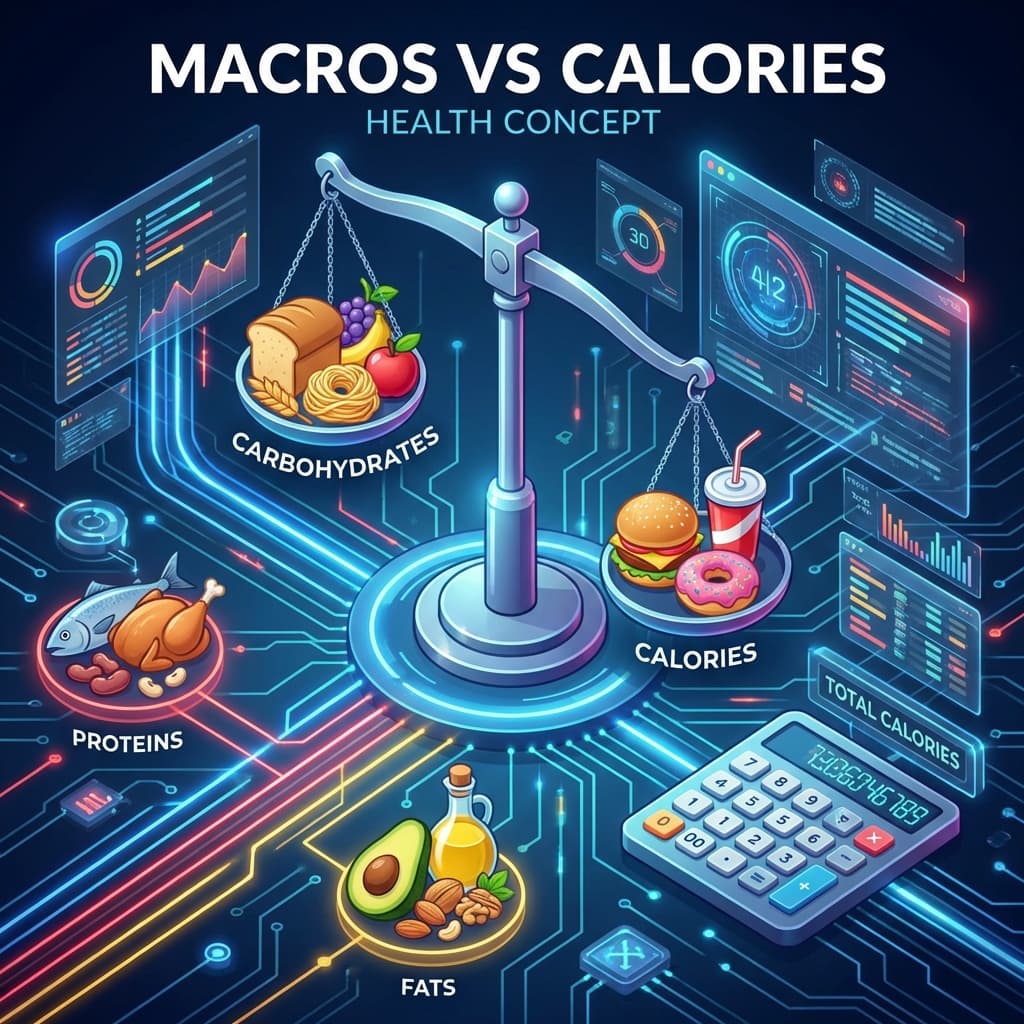
Macros vs. Calories: Why You Aren't Losing Weight Eating 1200 Calories
2026-01-06 • RedSun IT Services
The "Starvation Mode" Myth
It is a story we hear from clients every single day. "I am eating 1,200 calories a day. I am hungry all the time. But the scale hasn't moved in three weeks. Is my metabolism broken?"
The short answer is: No, your metabolism isn't broken. But your math might be too simple. For decades, we were taught that "A calorie is a calorie." That 100 calories of cookies is exactly the same as 100 calories of chicken breast. From a pure physics standpoint (thermodynamics), that is true. Energy in vs. Energy out. But from a biochemical standpoint, your body treats those two fuel sources completely differently.
If you are stuck at a weight loss plateau, the solution is rarely to eat less. The solution is usually to fix your Macros.
What Are Macros?
"Macros" is short for Macronutrients. These are the three main building blocks of food that provide energy. Unlike "Micronutrients" (vitamins and minerals), Macros are needed in large amounts.
1. Protein (4 Calories per gram)
The Builder. Protein is the most important macro for weight loss. Why?
- Satiety: It makes you full. You can eat 1,000 calories of chips and be hungry an hour later. If you eat 1,000 calories of steak, you won't want to eat for hours.
- TEF (Thermic Effect): Your body burns 20-30% of the protein calories just digesting them! If you eat 100 calories of protein, your body only nets about 75. It is a metabolic cheat code.
- Muscle Preservation: When you diet, your body tries to burn muscle for fuel. High protein signals the body to burn fat instead.
2. Carbohydrates (4 Calories per gram)
The Energy. Carbs are not the enemy. They are your brain and muscle's preferred fuel source. However, not all carbs are equal.
- Simple Carbs (Sugar): Spike insulin, lead to fat storage.
- Complex Carbs (Oats, Rice, Veggies): Provide steady energy. If you are sedentary (desk job), you need fewer carbs. If you are an athlete, you need more.
3. Fats (9 Calories per gram)
The Regulator. Fat is dense energy. It has more than double the calories of protein or carbs. But you need fat. It regulates hormones (testosterone, estrogen) and absorbs vitamins. Low-fat diets often lead to hormonal crashes and bad skin. The key is moderation. 30 grams of almonds is healthy; 300 grams is a calorie bomb.
The "Skinny Fat" Trap of Calorie Counting
Here is why your 1,200 calorie diet is failing. If you eat 1,200 calories of mostly carbs (bagels, pasta, fruit) and very little protein, your body enters a catabolic state. It realizes it isn't getting enough energy. Since you aren't giving it protein to repair muscle, it decides that muscle is "expensive tissue" to maintain. It starts burning your muscle for fuel.
You might lose weight on the scale, but your body fat percentage can actually go up. You end up weighing less, but looking softer and feeling weaker. This is the definition of "Skinny Fat."
How to Calculate Your Macros
To shift from "Weight Loss" to "Fat Loss," you need a Macro Split. A common starting point for 2026 is the 40/30/30 split:
- 40% Protein
- 30% Fats
- 30% Carbs
Step-by-Step Guide
- Find Your TDEE: first, determine how many calories you need total. Use our Calorie Calculator.
- Set Your Protein Target: A good rule of thumb is 0.8g to 1g of protein per pound of goal body weight.
- Example: Goal weight 150lbs -> Eat 150g Protein.
- 150g Protein x 4 cal = 600 Calories.
- Fill the Rest:
- If you love fats (avocado, nuts), prioritize fat calories.
- If you love carbs (rice, pasta), prioritize carb calories.
- As long as protein is high and total calories are in a deficit, you will lose fat.
Tracking in the Real World
You don't need to be a mathematician. Apps like MyFitnessPal or Cronometer make this easy. But before you download them, start with the basics: Look at your plate. Is there a palm-sized portion of protein? Is there a thumb-sized portion of healthy fat? Is the rest vegetables or complex carbs?
The Verdict
Stop obsessing over the number 1,200. If you increase your calories to 1,500 but double your protein intake, you might find that the scale finally starts moving again. You will feel more energetic, your workouts will improve, and you will build the lean, toned physique you actually want—not just a smaller version of your current self. Using our BMI Calculator and Calorie Calculator together gives you the complete data set to master your metabolism.